Outline 4.2 Testing the “Where” Stream (FEF Connectivity)
- Core Argument dieses Kapitels definieren
To-Do’s
- check wording
- check soruces
4.2 Testing the “Where” Stream (FEF Connectivity)
To evaluate the precise anatomical pathways of the top-down auditory attention network, the functional connectivity was assessed using full and partial correlation, revealing a clear spatial-dorsal pattern that places the FEF within its established framework.
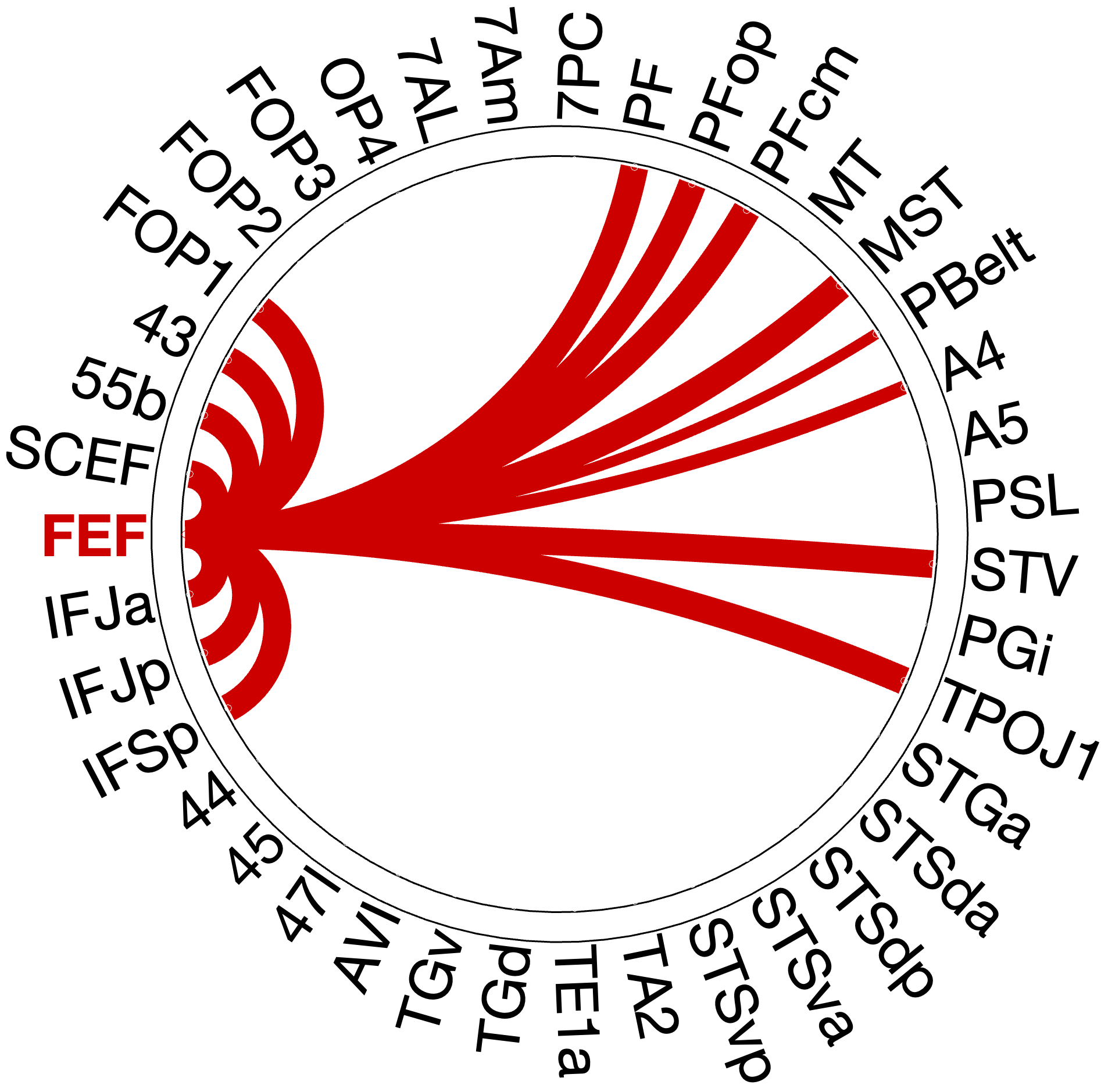
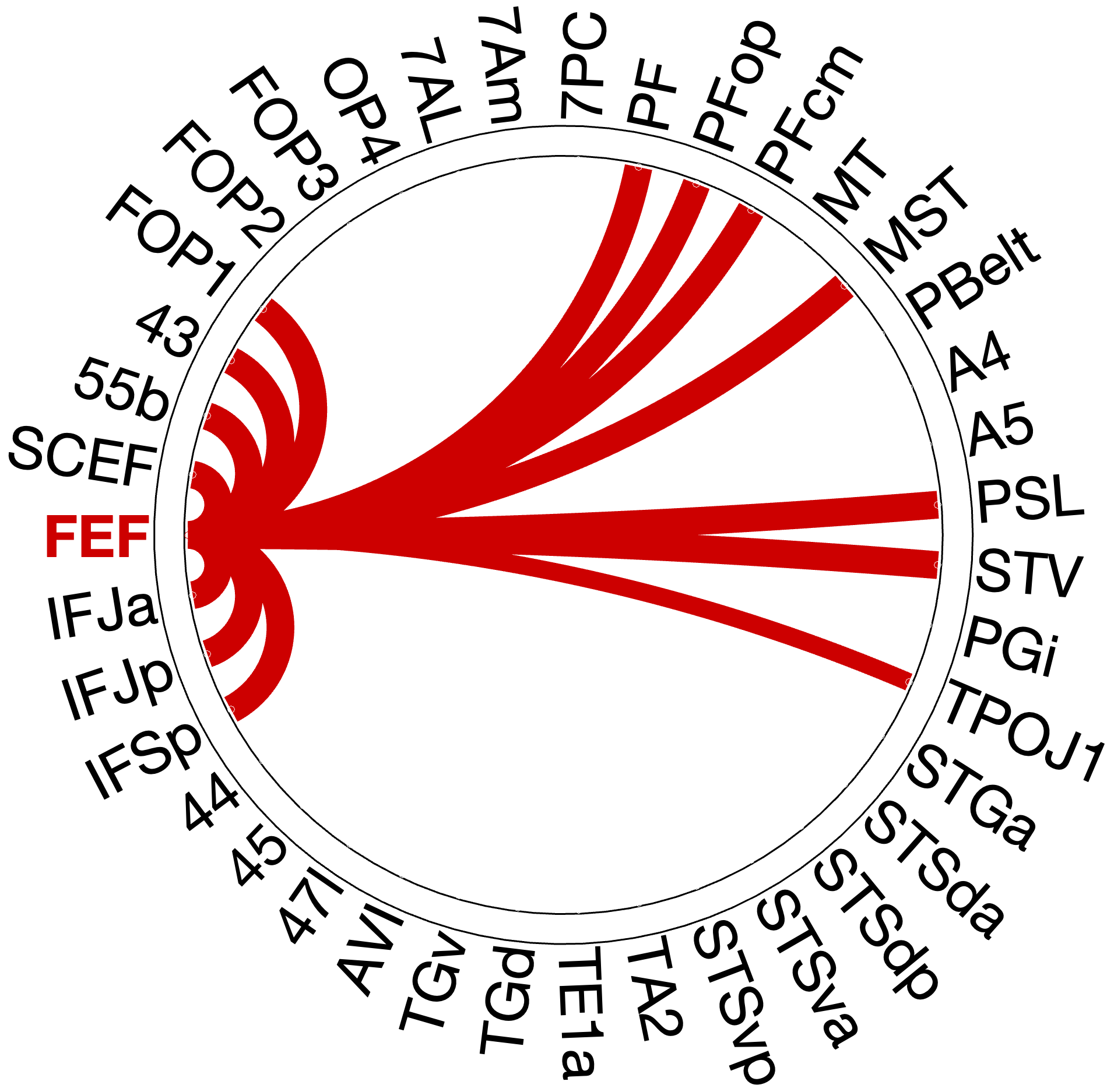
Figure 4.5: FEF single-seed partial correlation connectivity profile, left (A) and right (B) hemisphere. Significant connections are concentrated in inferior parietal (PF, PFop, PFcm), premotor-opercular (SCEF, 55b, FOP1), and motion- sensitive (MST) regions. This spatial-motor distribution is consistent with a dorsal ‘where’-stream profile under FEF top-down control.
4.2.1 Inferior Parietal Connection
In visual stream models, FEF couples strongly with the superior parietal lobule areas 7PC, 7AM and 7AL. However, partial correlation reveals a strong contrast, not showing significant coupling of FEF to superior parietal regions 7AL, 7AM and 7PC, although still coupling bilaterally with inferior parietal regions of PF (left , ; right , ), PFop and PFcm.
4.2.2 Premotor cluster (“How” Stream)
The strongest connections with FEF are the premotor and frontal opercular areas. The SCEF (left , ; right , ) and area 55b (left , ; right , ) form a bilateral motor-premotor cluster, along with FOP1 and area 43. Together these areas might form the “how” stream, proposed by Hickok & Poeppel 2007 - Nature, connecting spatial information with motor action plans.
4.2.3 Resolving Superior Parietal and Inferior Temporal Connections
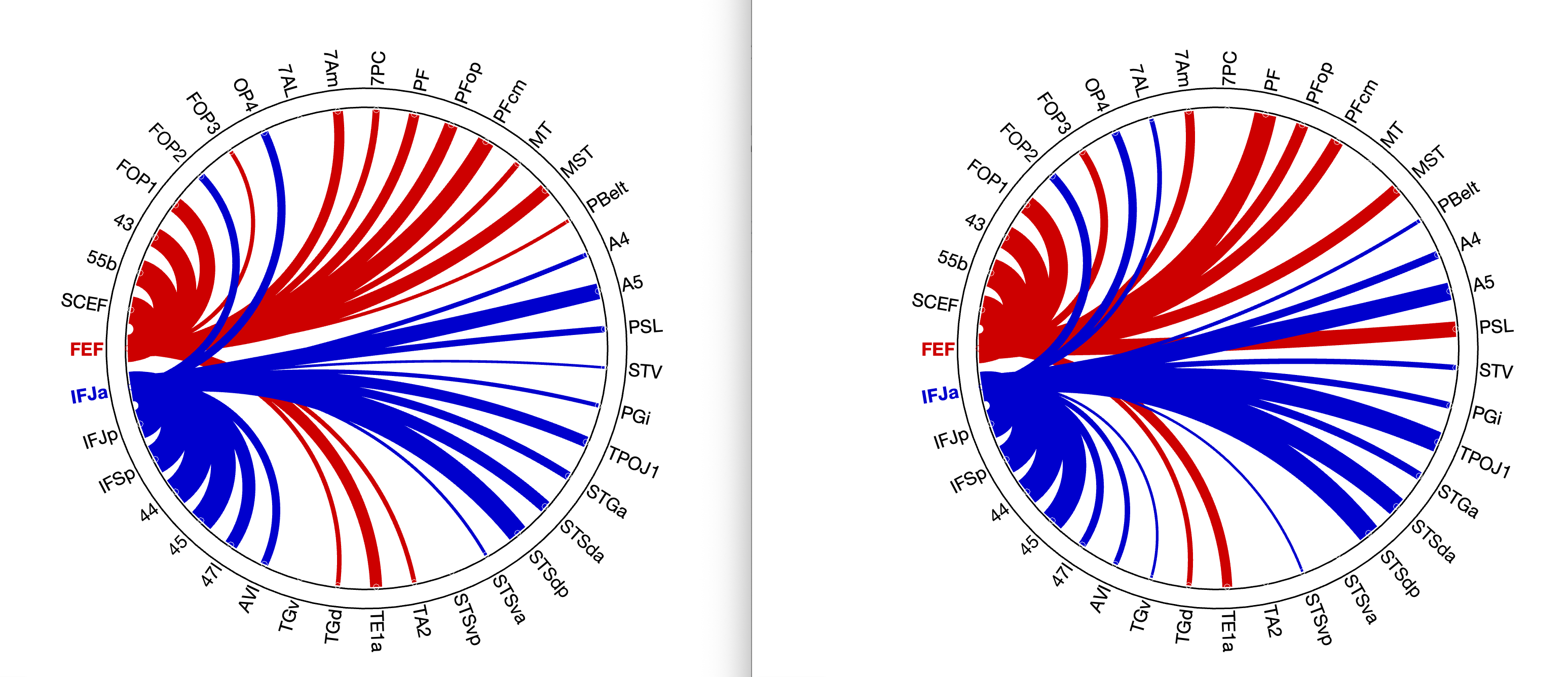
A crucial topological misconception emerges when comparing full and partial correlation profiles. In the full correlation, the FEF exhibits strong coupling with superior parietal areas (e.g., 7Am: left ; 7PC: left ). However, in the partial correlation model, these connections vanish entirely. This demonstrates that FEF does not maintain full spatial connections with superior parietal lobule when partialling out auditory ROIs. For auditory-spatial information, FEF mainly recruits Inferior Parietal Lobule (PF/PFop) and motor-sensitive areas. Furthermore, temporal areas that appear significant in Z-scores in figure FEF vs IFJa part corr.png (TE1a, TA2, TGd) show no substantial effect size (), suggesting that the FEF remains functionally decoupled from the ventral “what” stream’s temporal regions.
4.2.4 Motion and Supramodal Integration
The FEF maintains direct functional access to spatial motion tracking. Partial correlation reveals bilateral coupling with the medial superior temporal area (MST: left , ; right , ). Additionally, multimodal convergence hubs STV (left , ; right , ) and TPOJ1 (left , ; right , ) show significant direct integration with FEF in both hemispheres (Rolls et al. (2023) - Cerebral Cortex).
The right hemisphere reveals an exclusive direct connection to the PSL (, ), which is entirely absent in the left hemisphere’s partial profile, indicating a right-lateralized pathway for abstract spatial-auditory processing (Rolls (2022) - NeuroImage).